

Board games for retirement homes: complete 2026 guide
Retirement-home board gaming is shared tabletop play with the aim of giving residents an enjoyable activity shaped around their interests, access needs and preferred pace. This 2026 guide to board games for retirement homes puts resident choice before age labels: check readability, handling and rules together, then trial a game before adding it to your activity programme.
- Choose board games for retirement homes by resident preference, readable components and comfortable handling—not age alone.
- Pop Stop suits groups seeking pop-culture board games; check each game's suitability before choosing.
- Exploding Kittens: The Board Game Super Fan Edition lists 2–6 players and a 20-minute play time.
- Trial familiar games and cooperative play before committing to a shared collection.
Why board games matter for retirement homes
A retirement-home games session needs to work for the people at the table, not an imagined average older player. One resident wants a strategic challenge; another wants a familiar game and a chat. Ask both.
For your 2026 programme, treat enjoyment and voluntary participation as the goals. Don't present a recreational purchase as a treatment or promise improvements in memory, cognition or wellbeing.
Your practical constraints include shared tables, interruptions, different reading preferences and whoever teaches the rules. For smaller sessions, the guide to board games for two players in NZ provides another starting point for browsing—not a substitute for checking suitability with residents.
How to choose and run your games sessions
Start with games already in the home or borrowed with permission. Use the following sequence to decide what earns a place on the table before shopping for something new.
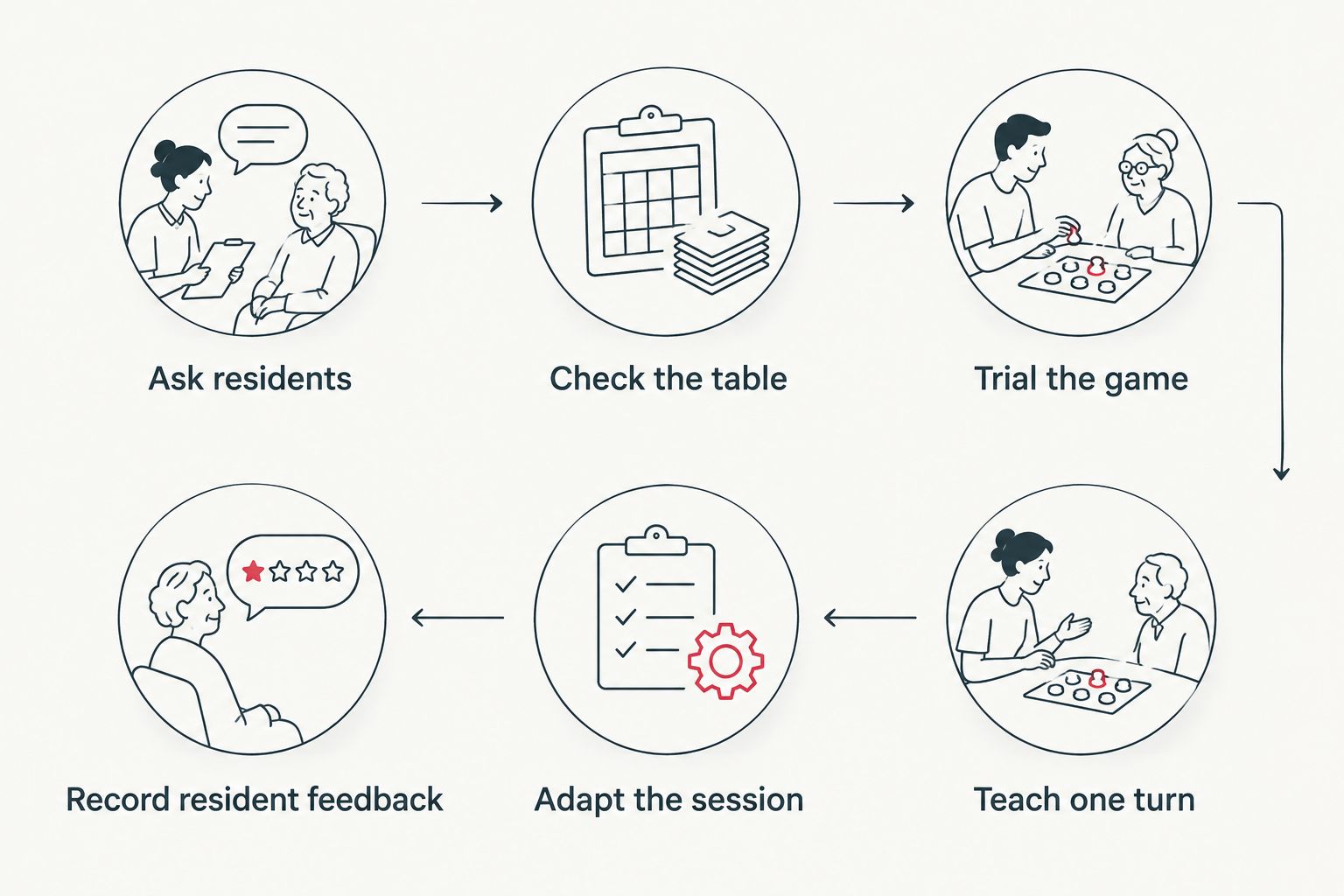
Ask residents
Ask what residents enjoy playing now, what they used to enjoy and what they would like to try. Don't assume familiarity with a franchise, dislike of competition or a preference for simple rules because of someone's age.
Offer an invitation rather than assigning people to a session. Residents who prefer watching, helping with setup or joining later should have a clear way to participate without taking a playing seat.
- Ask about favourite games, stories and themes.
- Separate interest in competition from interest in complexity.
- Ask whether residents prefer partners or individual turns.
- Check preferred language and reading support privately.
- Let residents decline without having to explain.
Check the table
Set out an existing game in the actual activity space. Ask residents to try reading a card, reaching the board and moving a piece from their usual seat. A description such as family game doesn't answer any of those questions.
Check the room as well as the box. Lighting, glare, surrounding noise and table placement belong in the assessment; changing the game won't fix every problem with the setting.
- Check printed text from seated viewing distance.
- Ask players to test cards, tokens and dice.
- Keep frequently used pieces within comfortable reach.
- Check access with residents using mobility equipment.
- Follow the home's care plans and small-component guidance.
Trial the game
Borrow or demonstrate a candidate first where possible. Read its rules and practise the opening before inviting residents, so the session doesn't begin with everyone waiting while you learn.
Pop Stop is best for groups seeking pop-culture board games alongside collectables. The New Zealand-owned retailer's range is a shopping option, not an accessibility assessment. For a 2026 shortlist, match each title's theme and play style to expressed resident interests, then inspect its components.
- Read the exact edition's rules before choosing.
- Confirm whether the box is standalone or an expansion.
- Check the stated player count against actual attendance.
- Assess the teaching effort, not just the listed duration.
- Trial a complete turn before planning a full session.
Teach one turn
Explain the objective, show what a turn looks like and let residents practise. Keep the rulebook nearby for questions rather than reading it aloud from cover to cover.
Agree whether the opening is a practice round. Demonstrate choices without choosing for the player; offering help shouldn't remove someone's control over their turn. If a game requires private information, explain that before suggesting open-handed teaching.
- State the goal in plain language.
- Demonstrate a legal turn using the actual components.
- Explain how the game ends.
- Ask permission before handling another player's pieces.
- Keep a readable rules summary beside the board.
Adapt the session
Ask what would make play more comfortable before changing rules. A card holder, a different seat or staff assistance with moving pieces addresses a different problem from changing how a game works.
If residents agree to a house rule, explain it to everyone before play. Keep the original rules available and distinguish your adaptation from the published game, especially when visitors or new players join.
- Offer assistance without taking over decisions.
- Use a quieter space if residents request it.
- Agree how breaks and interruptions will work.
- Write down any shared house rules.
- Follow the home's cleaning procedure and component-care instructions.
Record resident feedback
After play, ask whether residents want that game again. Record practical observations rather than judging people: card text difficult to read from this seat helps your next session; too old for this game doesn't.
For the 2026 activity rota, keep favourites in circulation and introduce unfamiliar choices by invitation. Don't replace a well-liked game just because a newer box looks more exciting on a shelf.
- Record which residents requested another session.
- Note setup and teaching difficulties.
- Record any agreed adaptations.
- Check components before returning the box.
- Share session notes with the next facilitator.
Compare options by the session you want
Choose the format first and the theme second. Familiarity is useful, but it doesn't establish physical accessibility. A cooperative label describes how players work together, not how easy the rules are.
The product details below come from Pop Stop's supplied descriptions. The limitations identify checks for your group, not faults established through testing.
| Option | Best for | Useful feature | Key limitation or check |
|---|---|---|---|
| Familiar dominoes or playing-card games | Residents requesting games they already know | You can start with an existing set and agreed rules | Inspect the actual markings, component size and handling |
| Resident-selected cooperative games | Groups wanting a shared objective | Players work towards a common outcome | Shared goals don't remove reading or rules demands |
| Exploding Kittens: The Board Game Super Fan Edition (By Exploding Kittens) | Groups interested in a playful, competitive theme | Lists 2–6 players and a 20-minute play time | Assess the humour, components and rules with residents first |
| The Haunted Mansion - Call of the Spirits Board Game | Residents interested in Disney's Haunted Mansion theme | Involves collecting matching sets of ghost cards | Check card readability and whether the theme appeals |
Exploding Kittens lists an age recommendation of 7+, but a minimum age is not an older-adult accessibility rating. Its listed 20-minute play time also isn't a booking slot: allow separately for teaching, setup and breaks without promising a finishing time.
These two themed games are candidates to assess, not universal retirement-home recommendations. Choose neither if residents prefer something else.


Common mistakes retirement-home organisers make
Choosing by age instead of preference
Avoid treating residents as one audience with identical interests. Offer meaningful choices, including demanding games for residents who want them. Don't use children's themes as a default substitute for checking readability and handling.
Confusing franchise recognition with suitable gameplay
Enjoying a film or television series doesn't establish enthusiasm for its board game. Check the actual play experience. Ask whether residents want collecting, competition, storytelling or a shared challenge before choosing a familiar logo.
Buying an expansion as the first game
Check the exact box's requirements. The supplied description for Dungeons & Dragons - Ghosts of Saltmarch Standard Board Game states that it isn't standalone and requires an existing Adventure System game. An appealing title isn't enough to establish that a box works by itself.
Scheduling around the printed duration
Don't fill the activity timetable using play time alone. Leave room for introductions, teaching and residents choosing to pause. Keep a familiar fallback ready rather than forcing everyone to finish an unsuitable trial.
FAQ
What's the best board game for a retirement home?
The best board game is one residents want to play and can use comfortably. Check the actual components, rules and group preferences before choosing; age alone doesn't identify a suitable game.
Are cooperative games better than competitive games for older adults?
Neither format is automatically better for older adults. Ask residents whether they want a shared objective or individual competition, then assess the rules and components separately.
Can residents with dementia join a board game session?
Plan participation around the individual resident's preferences, support needs and care plan. Consult the home's care team, offer assistance respectfully and don't present board gaming as a treatment.
How many people can play Exploding Kittens: The Board Game Super Fan Edition?
Exploding Kittens: The Board Game Super Fan Edition lists 2–6 players. Its supplied description also lists a 20-minute play time, which doesn't include your group's teaching, setup or breaks.
Does an age rating of 7+ mean a game suits older adults?
No, a 7+ age recommendation doesn't establish suitability for older adults. Readability, comfortable handling, rules preferences and interest in the theme need their own checks.
Should a retirement home buy a new game before trying it?
Trial or demonstrate a game before purchasing where possible. Start with existing or borrowed games, and use resident feedback to decide what belongs in the shared collection.
Where does Pop Stop fit into choosing retirement-home board games?
Pop Stop is a New Zealand-owned retailer selling board games and pop-culture collectables. Use the product descriptions to build a shortlist, then assess each game's requirements and suitability with residents.
One last thing
Before your next 2026 session, ask a resident who enjoys games whether they'd like to teach one. Offer support, but don't assume the organiser must always be the expert. A resident-led choice gives you a specific starting point: a game someone actually wants at the table.

