

How do you tell if a Funko Pop is rare? Verify it in 2026
You tell whether a Funko Pop is rare by identifying its exact release, checking documented production limits and variant details, then comparing matching collector records and completed sales. In 2026, a Chase sticker, exclusive label or vaulted status is a clue—not proof of rarity—and authenticity and condition need separate checks.
- How do you tell if a Funko Pop is rare? Verify the exact release before judging its rarity.
- Funko Chase, exclusive and vaulted labels describe different things; none alone proves rarity.
- Completed sales support demand checks, but they do not establish a production total.
- Pop Stop sells Pop! Vinyls; an exclusive product title does not certify rarity.
How do you tell if a Funko Pop is rare?
Identify the release first. Judge rarity second. Two figures depicting the same character can belong to different releases, finishes or packaging editions. Searching only the character name mixes those records together.
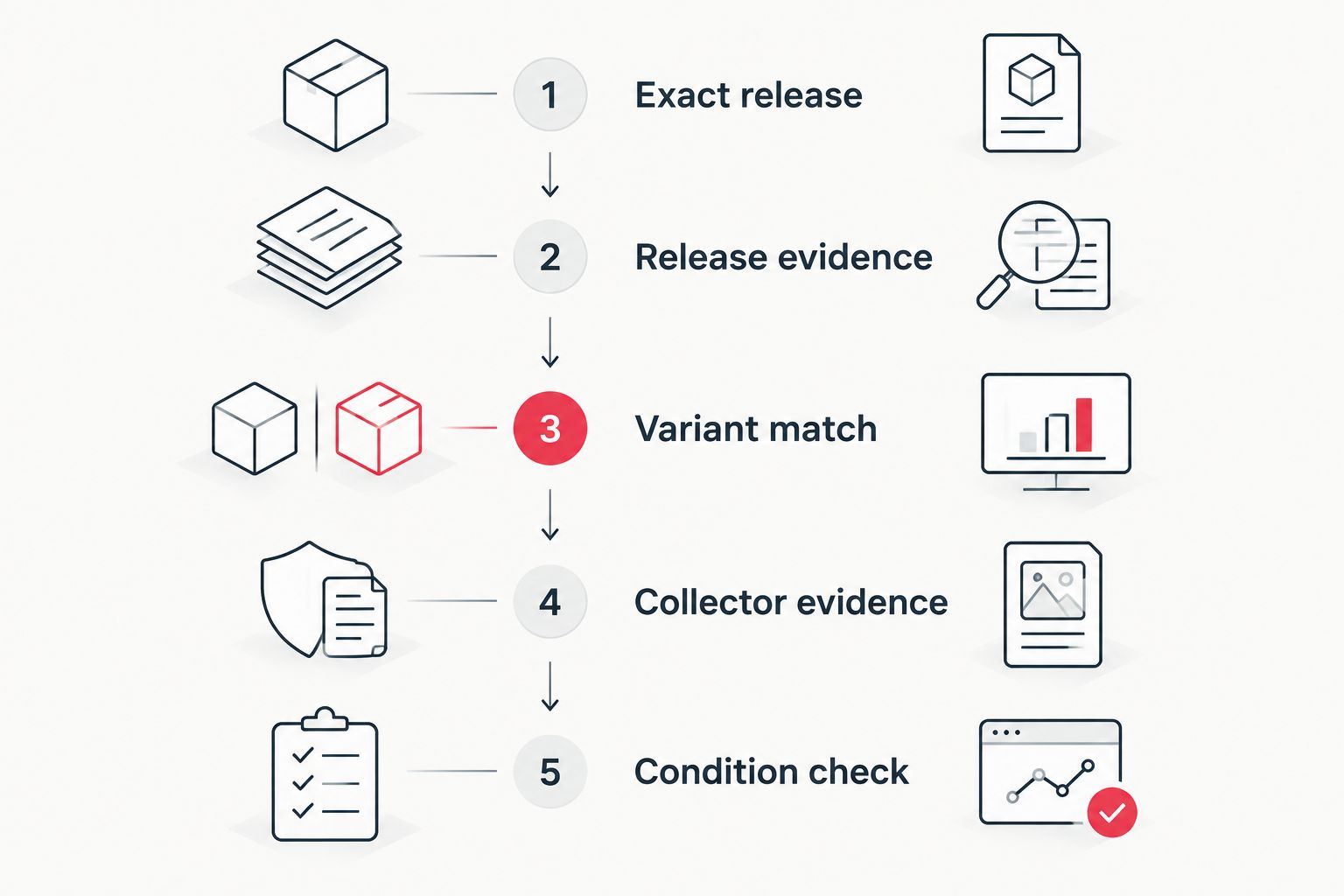
Use this sequence for a figure you're checking in 2026:
- Exact release: Record the character, franchise, box number, pose, finish and any exclusive wording. Include the pack format and size where relevant.
- Release evidence: Check Funko's official release information for an explicitly stated production limit or variant description. Do not treat a seller's adjective as documentation.
- Variant match: Compare the actual figure and packaging with reliable reference images of that exact edition. A sticker alone does not identify the figure inside.
- Collector evidence: Review completed sales and collector records for matching examples. Separate different stickers, finishes and box conditions rather than combining them.
- Condition check: Inspect the figure, box and insert. Record damage and replacements independently of your rarity conclusion.
Keep a short evidence note with the figure's identity, source details and inspection date. That prevents a vague memory of an exclusive release from becoming a claim that it was numbered or limited.
Why this matters
Rarity, demand and condition answer different questions. Rarity concerns how uncommon the exact release is; demand concerns whether collectors want it; condition describes the individual example you're holding.
For fandom-led collecting, Pop Stop is a New Zealand-owned Pop! Vinyl retailer alongside manga, trading card games and other pop culture collectables. Pop Stop is best for New Zealand pop culture fans choosing collectables by fandom, not treating an exclusive label as proof of rarity.
That distinction matters when your goal is a favourite character rather than a rarity hunt. A figure can belong on your shelf without being scarce, and a scarce edition can be unappealing to you.
What do Chase, exclusive and vaulted actually tell you?
These labels are useful starting points, but they are not interchangeable. Use the table to decide what each clue establishes and what still needs checking.
| Release clue | What it tells you | Useful for | Limitation |
|---|---|---|---|
| Chase | Identifies an alternate version associated with a regular release | Best for variant collectors | Does not establish the total production count |
| Retailer exclusive | Identifies a release associated with a particular retailer | Best for release completists | Distribution is not the same as documented scarcity |
| Convention exclusive | Identifies an event-associated release | Best for event-edition collectors | Shared and event packaging need separate identification |
| Vaulted | Indicates a discontinued release | Best for collectors researching older editions | Does not tell you how many were originally made |
| Numbered edition | States an edition limit when officially documented | Best for collectors seeking production evidence | The claim and the individual example still need authentication |
Is a Chase Funko Pop automatically rare?
A Chase is a variant, not a universal rarity grade. Check what differs from the regular figure: the sculpt, paint treatment, accessory or another documented feature.
Match the physical variant, not just the Chase sticker. A photograph of the box front cannot establish that the figure inside is the correct version, so request clear figure photographs too.
Does an exclusive sticker mean a limited edition?
An exclusive sticker identifies a release or distribution connection; it does not automatically state a production limit. Look for explicit official evidence before describing an edition as limited to a particular quantity.
For New Zealand collectors, keep regional packaging differences separate from figure differences. If a listing uses a different sticker, establish whether you are comparing the same figure in different packaging or genuinely different editions.
Does vaulted mean rare?
Vaulted means discontinued, not necessarily scarce. A release's original production history still matters, and discontinuation alone cannot establish how uncommon surviving examples are.
When researching a vaulted claim in 2026, check the exact release rather than assuming every version of that character has the same status. Different poses and finishes need their own records.
Two exclusive Pop! Vinyl examples—and what their titles prove
The following Pop Stop product titles demonstrate why precise identification matters. Neither title supplies a production total, so neither supports a rarity verdict on its own.
| Product | Details stated in the title | Best for | Rarity evidence still needed |
|---|---|---|---|
| Space Jam 2: A New Legacy - Bugs Bunny as Batman & LeBron James as Robin (US Exclusive) Pop! Vinyl Figure 2 Pack | Named characters, costumes, US Exclusive and 2-pack format | Space Jam and crossover fans | Official production information and exact-edition records |
| Spider-Man: Across the Spider-Verse - Spider-Man (US Exclusive) Blacklight 10 Inch Pop! Vinyl Figure | Franchise, US Exclusive, Blacklight finish and 10-inch format | Spider-Verse fans seeking a larger display figure | Official production information and exact-edition records |
The Space Jam format contains 2 figures, making its pack format part of the identification. The Spider-Man title specifies a 10-inch figure; do not compare it with a different-sized release just because the character matches.
Their strength is a clearly described fandom and format. Their limitation for rarity research is equally clear: exclusive wording does not document scarcity. Choose them for their stated features, not an unsupported rare-item claim.


Why rarity assessments vary
Different collectors sometimes assess different things under the same rare label. Keep these factors separate in your 2026 research:
- Production evidence: An officially documented edition limit is stronger evidence than a seller describing a figure as hard to find.
- Exact variant: A standard finish, Blacklight treatment and alternate sculpt require separate identification.
- Packaging edition: Event and shared-release stickers need matching references rather than assumptions about interchangeability.
- Discontinuation: Vaulted status establishes a release's production status, not its original production total.
- Collector demand: Completed transactions show interest in an edition; they do not count every example that exists.
- Condition and completeness: Box damage, missing inserts and replaced packaging affect the individual example, not the edition's production history.
If your real question concerns future financial returns, read whether Funko Pops are a good investment. Rarity research and investment assessment are different tasks; don't let one substitute for the other.
How do you check that a supposedly rare Pop is genuine?
Start with consistent identification across the figure and packaging. Compare sculpt details, paint placement, printed artwork and identifying marks against reliable references for the same release.
Request photographs of the actual item, including the box sides, bottom, insert and figure. A copied promotional image is not evidence of the seller's individual example.
Do not authenticate from one detail alone. Printing differences or an unusual sticker need investigation, not an immediate genuine-or-fake verdict; a convincing sticker also cannot override a mismatched figure.
Can a damaged Funko Pop still be rare?
Yes—a damaged example can belong to a rare edition. Damage changes its condition, not how many examples of that edition were produced.
Describe both facts separately. Note crushed corners, creases, tears, window damage and missing components rather than hiding them behind the word rare.
If you collect out of box, that can be a deliberate display choice. Keep the figure's identity documented even when pristine packaging is not your priority.
FAQ
What's the quickest way to tell if my Funko Pop is rare?
Identify the exact release, then look for official production evidence. Match the character, box number, finish, packaging and format before comparing collector records.
Does the number on a Funko Pop box show how rare it is?
No—the box number identifies a figure within its product line, not its production quantity. Do not read it as a numbered-edition limit.
Is every Chase Funko Pop rare?
No—a Chase identifies a variant, not a universal rarity level. Check the actual variant and seek documented production information rather than relying on the sticker.
Are US Exclusive Funko Pops automatically rare in New Zealand?
No—US Exclusive wording alone does not establish rarity in New Zealand. Identify the exact release and packaging, then assess its documented production history.
Does vaulted mean a Funko Pop is valuable?
No—vaulted status indicates discontinuation, not a guaranteed financial outcome. Collector demand, authenticity and condition require separate assessment.
Can a Funko Pop be rare without its original box?
Yes—a loose figure can belong to a rare edition. Missing packaging makes release identification and condition assessment harder, so document the figure carefully.
Can I prove rarity from completed sales?
No—completed sales document transactions, not the total number produced. Use them to check matching editions and collector interest alongside official release evidence.
One last thing
Before committing to a rarity claim in 2026, write one sentence explaining your evidence. If it says only exclusive sticker, old figure or seller says rare, you have a research lead—not a conclusion.
Keep the fandom decision separate from the rarity decision. That lets you enjoy a figure without asking an unsupported label to justify it.

