

Gundam Model Kits for Hobbyist Workshops: 2026 Guide
Gundam model kits for hobbyist workshops are High Grade, Real Grade, Master Grade or Perfect Grade plastic kits built at a dedicated bench with proper tools, not display pieces snapped together on a coffee table. A workshop setup changes what you buy, how much desk space you need, and which grade makes sense for your first build in 2026.
- HG kits are the right entry point for gundam model kits for hobbyist workshops in 2026 -- buy HG before RG or MG.
- A dedicated bench needs a cutting mat, side cutters and ventilation before your first build.
- RG kits pack inner-frame detail that rewards customisation; MG and PG suit builders with bench time to spare.
- Store unbuilt kits flat and out of direct light -- runners warp in a hot garage.
- Pop Stop stocks HG, RG and 30MM mecha kits for NZ builders alongside its wider anime range.
Why gundam model kits matter for hobbyist workshops
A workshop is not a display shelf. Hobbyists building at a bench care about grade progression, tool compatibility, and how many kits are queued up waiting to be built -- not just which one looks good in a case.
Bandai's grade system (SD, HG, RG, MG, PG) exists because kit engineering scales with skill and bench time. A workshop treats that ladder as a build plan: HG to learn nippers and panel lining, RG or MG once technique is solid, PG when a single kit might take weeks. Pop Stop runs the same idea across its whole model kit shelf, not just Gundam-branded lines.
Storage matters just as much as building. Unbuilt kits sitting for months need care too -- boxes left in sunlight or a hot garage fade the art and can warp the plastic runners before the bag is even opened.
Setting up a hobbyist workshop for Gundam model kits
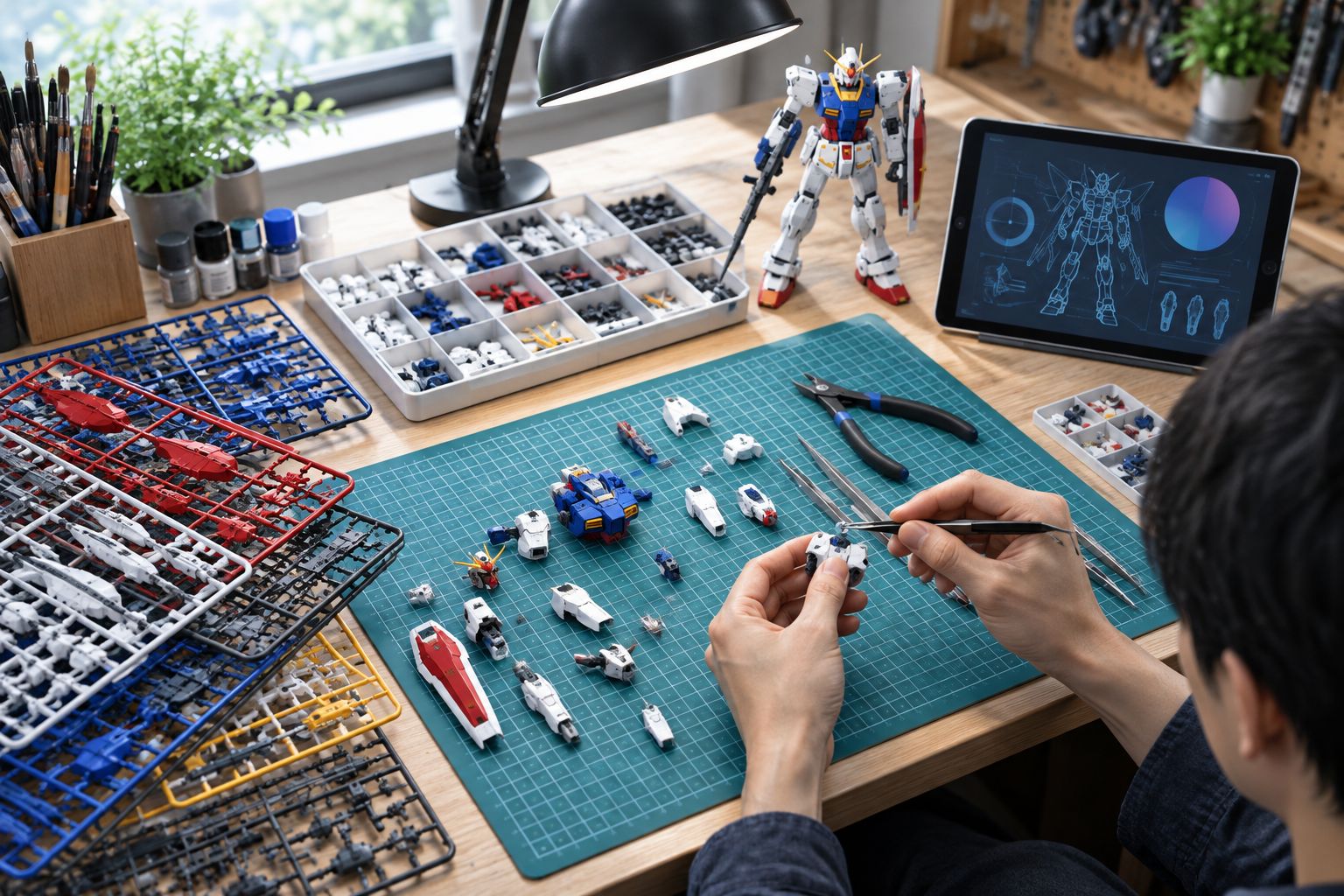
Set up your bench before you buy a kit
- A cutting mat sized A3 or larger to catch runner tag cuts
- A dedicated pair of side cutters (nippers) -- not household scissors
- Tweezers for polycaps and small joint parts
- A desk lamp with even, glare-free light
- Small parts trays so nothing rolls off the bench
Pick your grade before you commit to a build
- High Grade (HG) -- snap-fit, 1/144 scale, the standard starting grade
- Real Grade (RG) -- 1/144 scale with an inner frame and tighter tolerances
- Master Grade (MG) -- 1/100 scale, more parts, room for panel lining and weathering
- Perfect Grade (PG) -- 1/60 scale, the longest build, mechanical inner frames
- SD (Super Deformed) -- chibi proportions, fast builds for testing new techniques
An HG kit teaches the fundamentals; jumping straight to Perfect Grade before that just wastes plastic. Pop Stop's model kit range isn't limited to Gundam-branded lines -- the same grade conventions turn up across other mecha kits, which is useful for practicing technique between Gundam builds.

Stock the tools that separate a workshop from a display shelf
- Panel line pen or enamel wash for recessed detail lines
- Sanding sticks in two or three grits for nub marks
- Topcoat spray (matte or flat) for a factory-fresh finish
- Cement or plastic glue only if the kit calls for it -- most HG and RG kits are snap-fit
- A parts organiser tray sorted by runner letter
Build a queue instead of one kit at a time
- Keep two or three kits in progress across different grades so drying time on one doesn't stall the bench
- Log build order by grade so skills compound from HG to RG to MG
- Photograph each stage before moving to the next kit -- useful for troubleshooting later builds
Store unbuilt kits so they survive the wait
- Stack boxes flat, not on end, to stop runners bowing
- Keep kits out of direct sun and away from a hot garage wall
- Bag opened kits with loose parts before shelving them
Track what you've built and what's next
- A simple spreadsheet or notebook with kit name, grade, scale and build date
- Note which tools or techniques worked, for the next kit at that grade
Which grade fits your workshop
| Grade | Best for | Key limitation |
|---|---|---|
| SD | Fast builds, learning grip and nub removal | Chibi proportions won't scratch the detail itch |
| HG | First real build, most workshop starter kits | Fewer inner-frame parts than RG or MG |
| RG | Detail work and customisation at small scale | Small parts are fiddly for first-time builders |
| MG | Panel lining, weathering, display-grade finish | Longer build time, more cement and paint needed |
| PG | A mechanical inner-frame project, not a first kit | Highest part count and bench-time commitment |
“An HG kit teaches the fundamentals; jumping straight to Perfect Grade before that just wastes plastic.”
Pop Stop's shelves carry other mecha kits that use the same grade conventions, worth adding to a workshop queue between Gundam builds.


Common mistakes hobbyist workshops make with Gundam model kits
- Building without dry-fitting first -- forcing a part that's slightly misaligned snaps pegs that panel lining can't fix.
- Skipping ventilation with cement or spray topcoat -- a closed garage or spare room needs airflow before solvent-based products come out.
- Storing opened kits loose in a drawer -- small polycaps and joints go missing faster than any other part on the runner.
- Jumping straight to Master Grade or Perfect Grade -- the extra part count and inner-frame assembly punishes builders who haven't done an HG or RG kit first.
- Buying display-only kits when the bench could handle more -- SD kits are fine for a quick project, but a dedicated workshop can usually handle HG and RG builds instead.
For a full breakdown of which specific kits suit a first build, Pop Stop's Gundam beginner guide covers grade-by-grade picks in more detail than a single workshop guide can.
FAQ
What's the best Gundam grade for a hobbyist workshop in 2026?
High Grade (HG) is the best starting grade for a hobbyist workshop in 2026 -- snap-fit assembly, 1/144 scale and enough parts to learn nippers and panel lining without overwhelming a first build.
Is Real Grade better than Master Grade for beginners?
Real Grade (RG) is more detailed at a smaller 1/144 scale, while Master Grade (MG) is a larger 1/100 kit with more parts and build time. Most workshops build one or two HG kits before either.
How much desk space do you need for Gundam model kits?
A single A3-sized cutting mat covers most HG and RG builds. Master Grade and Perfect Grade kits benefit from a wider bench because of the higher part count and longer session times.
Do Gundam model kits need paint and cement?
Most HG and RG kits are snap-fit and don't require cement. Paint and topcoat are optional extras for a workshop finish, not requirements to complete the build.
What tools do I need to start building Gundam kits in 2026?
A cutting mat, a dedicated pair of side cutters, tweezers and a well-lit bench cover the essentials. Panel line pens and sanding sticks come next once the basics are comfortable.
Are High Grade kits worth building for adult hobbyists?
Yes -- HG kits are engineered for clean assembly and good proportions at a lower part count, which makes them the fastest way to build technique before moving to RG or MG.
How do I store unbuilt Gundam kits so they don't warp?
Stack boxes flat rather than on end, keep them out of direct sunlight, and avoid hot garages or window sills. Heat and light warp runners and fade box art over months of storage.
Is Master Grade or Perfect Grade better for detail work?
Perfect Grade has the most detailed mechanical inner frame of the two, but it also has the highest part count and longest build time -- not a first kit for a new workshop.
One last thing
The single upgrade that matters most for a hobbyist workshop isn't paint -- it's proper nippers. Cutting flush instead of tearing tabs off by hand is the difference between a kit that needs putty and one that doesn't, and it costs less than most single HG kits.

