

Magic: The Gathering for competitive players: complete 2026 guide
Competitive players’ Magic: The Gathering preparation is structured deckbuilding, matchup practice and rules checking aimed at stronger tournament results. This 2026 guide puts format legality before purchases and post-sideboard practice before last-minute deck changes.
- Magic the gathering for tournament players starts with format legality, a tested decklist and a clear sideboard plan.
- Pop Stop suits New Zealand players buying sealed Magic products; targeted singles suit exact decklist upgrades.
- Practise post-sideboard games, not just opening hands, and record why each matchup changes.
- Choose boosters for Limited play or collecting, not as a dependable route to specific tournament cards.
Why tournament preparation matters for competitive players
Tournament Magic asks more of your deck than a casual game night. You need legal cards, repeatable decisions and a plan for opponents who know how to disrupt yours. A favourite card earns its slot by doing a job, not by looking spectacular in one game.
Pop Stop is best for New Zealand tournament players seeking sealed Magic: The Gathering products rather than exact-card upgrades. Pop Stop is a New Zealand-owned online and retail store selling trading card games alongside pop culture collectables; keep that shopping role separate from your deck-testing process.
For your 2026 event calendar, start with the organiser’s published format and event instructions. A competitive Commander list, a Standard deck and a Sealed pool solve different problems. Buying first and checking the format afterwards reverses the useful order.
How to prepare for a Magic tournament
Confirm your format and event rules
Read the event listing before choosing a deck. Standard, Pioneer and Modern have different card pools, while Limited uses cards opened or drafted for that event. Commander has its own deck-construction rules; do not assume a casual Commander night and a competitive event use identical expectations.
Under the Magic Tournament Rules, most Constructed formats require at least 60 cards in the main deck and allow a sideboard of up to 15 cards. Limited decks require at least 40 cards. Format-specific exceptions matter, so check the official rules that apply to your event.
- Confirm the format, start time and registration process.
- Check the current banned and restricted announcements for that format.
- Confirm whether the organiser requires decklist submission.
- Read any published instructions about proxies and tournament policy.
Choose a deck you can explain
Start with cards you own and a written list. Identify how the deck wins, which opening hands support that plan and what makes you mulligan. A copied list is a useful starting point, but it does not explain the decisions for you.
For 2026 preparation, favour a list you can practise over a last-minute switch based on an isolated result. Separate evidence from excitement: record whether a loss came from sequencing, resource management, a weak matchup or an actual deckbuilding problem.
- Write down the primary win condition and backup plan.
- Identify hands with spells but no workable mana sequence.
- Explain the role of each flexible main-deck slot.
- Keep a dated list so you know which version produced each result.
Separate deck needs from pack opening
Compare your tested list with your collection manually before shopping. Mark every missing card and distinguish essential pieces from optional experiments. That gives you a specific acquisition plan instead of a pile of packs and a hope.
Pop Stop’s Magic: The Gathering range gives you a sealed-product route when sealed products match your goal. For an exact Constructed upgrade, pursue the exact card; for Limited preparation, choose the relevant draftable product. Collector-focused packs serve a different purpose and do not replace a tournament decklist.
- Make a missing-card list with the required quantities.
- Separate tournament essentials from alternate-art preferences.
- Check the exact product type and language before choosing packs.
- Confirm the event’s specified set and supplied materials for Limited.
Practise matchups with a repeatable process
Use a notebook or shared document before adding any tracking software. Record the opposing archetype, play or draw, sideboarding changes and the decision that mattered. A result without context tells you less than a clear explanation of a lost turn.
In 2026, keep your testing notes tied to the deck version and event format. Practise post-sideboard games as deliberately as opening games: extra interaction changes which threats survive and which hands remain keepable.
- Alternate who plays first during practice.
- Replay difficult turns with both hands revealed afterwards.
- Record mulligan decisions separately from match outcomes.
- Change a defined part of the list, then test that change.
Build sideboard plans around specific jobs
Write a matchup plan before changing sleeves. Name what each incoming card answers and what you remove to make room. Adding interaction without removing the right cards can leave you with answers but no way to win.
A sideboard guide is a preparation document, not permission to consult outside notes whenever you want. The Magic Tournament Rules distinguish between notes used during a game and brief reference to outside notes between games; check the current policy and ask a judge when unsure.
- Assign each sideboard card a matchup or tactical purpose.
- List the corresponding cards you intend to remove.
- Preserve enough threats and mana sources after sideboarding.
- Rehearse plans for both play and draw where they differ.
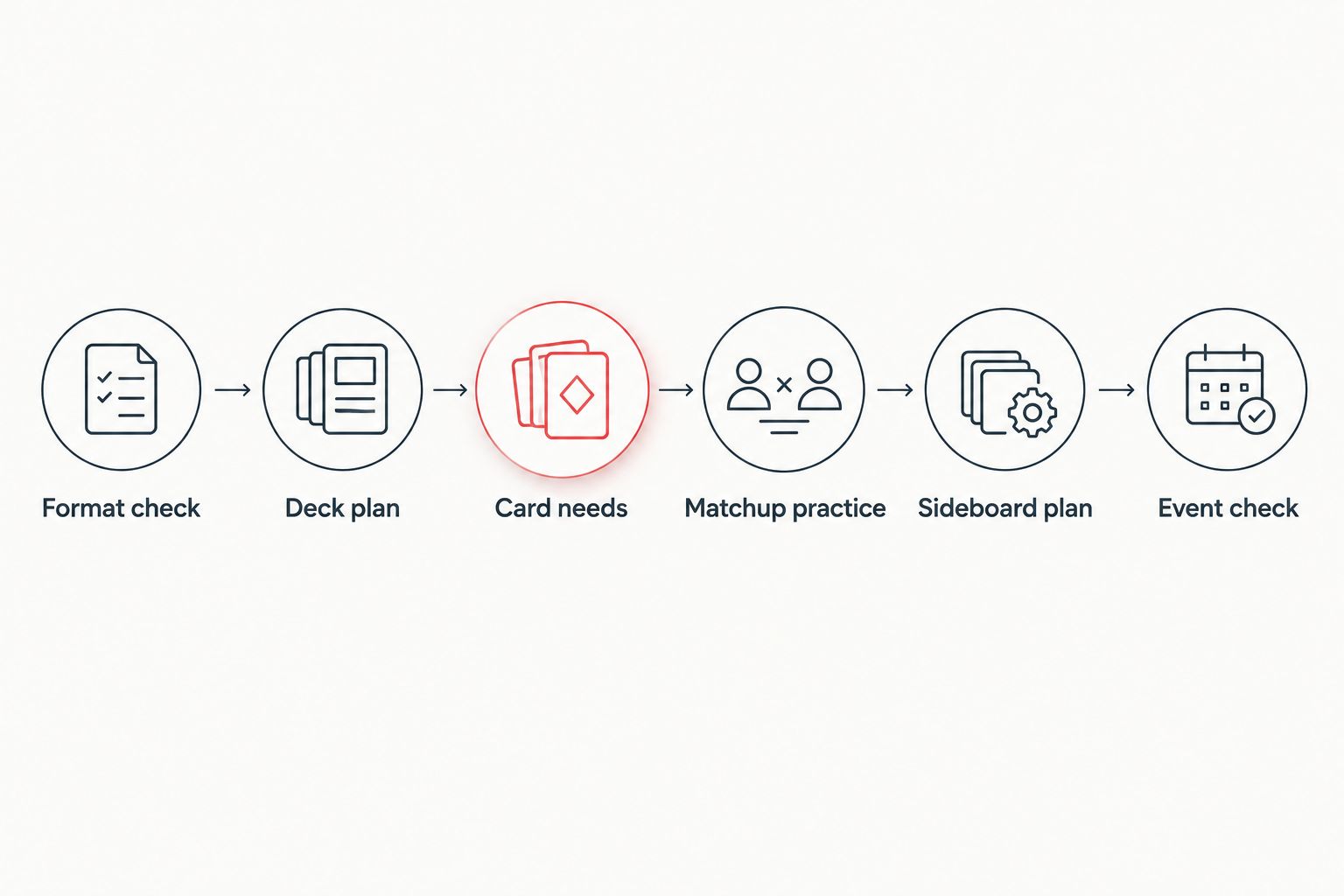
Your preparation follows a simple sequence: Format check, Deck plan, Card needs, Matchup practice, Sideboard plan, Event check. Complete the early decisions before polishing the later ones.
Check your physical deck and tournament habits
Lay out your main deck and sideboard separately, then compare them against your submitted list. Check sleeves for visible differences, replace damaged sleeves and keep unrelated cards away from the tournament deck. Presentation matters when a distinguishable card back creates a marked-card concern.
Before a 2026 event, practise communicating phases, targets and life-total changes clearly. Ask a judge when a rules disagreement arises rather than negotiating an improvised ruling. Your opponent is not responsible for teaching you the interaction your deck depends on.
- Count the main deck and sideboard against the final list.
- Pack suitable tokens, counters and a way to record life totals.
- Check sleeves and card orientation for distinguishable differences.
- Confirm travel arrangements and the organiser’s check-in instructions.
Compare your tournament preparation options
Match the option to the job, not the packaging. Existing cards let you test immediately; targeted singles address exact gaps. Sealed packs make sense when opening those packs is part of your chosen activity.
| Option | Best for | Main advantage | Key limitation |
|---|---|---|---|
| Existing collection | Testing a first list | Lets you identify gaps before acquiring cards | Missing cards limit faithful practice |
| Targeted singles | Completing a Constructed decklist | Gives you the specific cards your list requires | You still need to check legality and condition |
| Magic the Gathering Reality Fracture Play Booster | Players comparing Play Boosters for Limited | Play Boosters are designed for Limited play as well as opening | Confirm the event’s set requirements; contents are random |
| Collector Boosters | Players who also collect special card treatments | Focus on collectible treatments | Random contents do not reliably complete a decklist |
For Pop Stop purchases, read the individual product listing rather than treating every Magic booster as interchangeable. A product’s set name does not establish that every card inside is legal in your format.
Common mistakes competitive players make
- Treating pack opening as deck completion. Random cards do not follow your missing-card list. Separate collecting from tournament acquisition.
- Testing only before sideboarding. Your deck must function after cards come in and out. Practise those configurations, not just the original list.
- Changing lists without keeping records. If you alter the mana, threats and interaction together, you cannot isolate which change addressed the problem.
- Confusing card treatment with legality. Foil, alternate-art and collector-focused presentation do not grant format legality. Check the card and format.
- Submitting a list before checking the physical deck. An accurate document does not fix a different deck in your sleeves. Compare both before play.
FAQ
What's the best way to start Magic the Gathering for tournament players?
Choose an event format, verify its current rules and practise a legal deck before buying upgrades. Use your existing collection to identify exactly what the deck needs.
Should I buy boosters or singles for a tournament deck?
Targeted singles suit exact Constructed deck requirements; boosters suit activities built around opening packs, including Limited. Random packs do not guarantee the cards on your decklist.
How many cards does a competitive Magic deck need?
Most Constructed formats require a main deck of at least 60 cards and allow a sideboard of up to 15 cards. Limited requires at least 40 cards, while formats such as Commander have different construction rules.
Can I use a Commander preconstructed deck in a Standard tournament?
A Commander preconstructed deck is not a Standard tournament deck. Standard has a different card pool and construction requirements, so check each proposed card against current Standard legality.
Do Collector Boosters make a tournament deck stronger?
Collector Boosters do not make a deck stronger simply because they contain collectible treatments. Competitive value depends on the actual card, its legality and its role in your list.
Can I bring sideboard notes to a Magic tournament?
Magic tournament policy permits brief reference to outside notes between games, subject to its rules. Do not consult those notes during a game; check the current Magic Tournament Rules and ask a judge about unclear situations.
Does Pop Stop sell products relevant to competitive Magic players?
Pop Stop sells Magic: The Gathering sealed products. Choose a product that matches your preparation goal, and check its listing rather than assuming a booster supplies particular tournament cards.
One last thing
Practise the turn after your best threat gets answered. Goldfishing shows what happens when nobody interferes; tournament opponents interfere on purpose. Before your next event, take your preferred opening sequence, remove its key threat and work out how the remaining hand wins.

